





New York City's five SCOOP Act bills became law without the mayor's signature. What the bag dispensers, park signs, dog run compost pilot and complaint rule change for you, and when.
This fall, New York City got five new dog poop laws. None was signed by the mayor. They are the law anyway.
Together they make up the SCOOP Act. Here is what each one does, when it starts and what stays the same.
The short answer
The SCOOP Act is five New York City dog waste bills, all now law. They require at least 1,200 bag dispensers on city litter baskets, signs at parks and dog runs, an education campaign, a dog run compost pilot and required Sanitation visits to problem blocks. Most start in 2027. The fine is still up to $250.
What is the SCOOP Act?
SCOOP stands for Safe and Clean Outdoor Ownership Practices. It is a package of five bills from the New York City Council aimed, in the Council's words, at "ensuring dog waste is picked up throughout all five boroughs."
The push followed a rough winter. Back-to-back snowstorms were followed by a spike in complaints: 311 logged 821 dog waste complaints citywide in January and February, up 35.8% from the same two months a year earlier, according to the Council. By August 13, the Council says, the 2026 count had reached 2,926, already 10% more than in all of 2025.
Is the SCOOP Act law?
Yes. The Council passed four of the bills on August 13, 2026, and the fifth on September 10. The mayor neither signed nor vetoed any of them.
That turns out not to matter. Under Section 37 of the New York City Charter, a local law the mayor neither approves nor returns with objections within 30 days is "deemed to have been adopted in like manner as if the mayor had signed it." Or, as the Council's own explainer puts it: "If the Mayor doesn't sign or veto the bill within 30 days, it becomes law."
So the calendar did the signing. The first four became law on September 12 as Local Laws 139 to 142 of 2026, each certified by the City Clerk as "returned unsigned by the Mayor on September 14, 2026." The fifth became Local Law 154 of 2026 on October 10.
When each part starts
Becoming law is not the same as taking effect, and most of the package has a built-in delay. Dates marked "by our count" are our arithmetic from each law's text.
1,200 bag dispensers on litter baskets
This is the one you are most likely to notice. Local Law 139 (Int. 857-A, from Speaker Julie Menin) has the Department of Sanitation (DSNY) put at least 1,200 bag dispensers on city litter baskets in all five boroughs, "prioritized in areas where there is the greatest need for dog waste mitigation." In plain English: problem spots first.
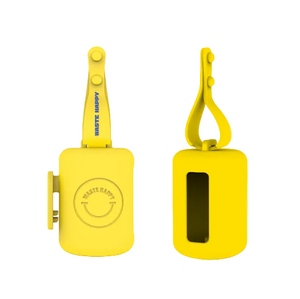
DSNY may sign up volunteer groups to refill them at least once a month; where it finds none, it refills them itself. (Block associations, this one is for you.) DSNY also has to post the program details on its website, so watch there.
It is a trial with an end date. DSNY reports by March 1, 2030 on how the dispensers affected complaints, and the law expires that June 30. We did not find a deadline in it for getting all 1,200 installed.
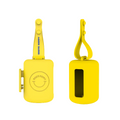
We are big fans of this one, for obvious reasons. A bag on the corner basket is a great backup. But it only helps when you are standing next to it, and your dog does not plan stops around litter baskets. Keep your own roll clipped to the leash (here is how to attach a dispenser to a leash) and you are never stuck.
Park signs and an education campaign
Local Law 142 (Int. 880-A, from Council Member Mercedes Narcisse) has the Parks Commissioner post signs, where practical, at the entrances of every park and dog run Parks oversees. Each sign summarizes the rule that whoever is in charge of a dog must promptly pick up and dispose of its waste.
Narcisse explained the thinking in the Council's announcement: "People leave dog waste on the ground because they assume nobody is watching and nobody is going to say anything to them." Once the law takes effect next spring, a sign is supposed to say something.
Local Law 141 (Int. 872-A, from Council Member Shahana Hanif) has the Health Department, working with DSNY, run a yearly education campaign, three years running, on picking up, the health risks of dog waste and the legal duty to remove it.
The dog run compost pilot
The most unusual piece is Local Law 140 (Int. 864-A, from Council Member Harvey Epstein). It has the Parks Department, working with DSNY, run a pilot in which experienced volunteer dog run groups (the groups that maintain a run under an agreement with Parks) collect dog waste at their runs for composting.
The groups handle the equipment, such as collection bins and self-contained composting vessels, and Parks has to supply and install it within 120 days if a group asks. Every dog run group should hear about it from Parks by December 11, by our count (90 days after the law took effect). At the end, Parks reports how much was composted and whether the runs ended up with less poop on the ground.
Epstein calls himself "an avid composter" and says he cannot wait to take part "when I take my dog, Homer, to the dog run."
Before you get ideas about the backyard: this is a managed pilot with its own equipment. Our guide to what to do with dog poop explains why composting dog waste at home is not recommended. If your run joins the pilot, follow its instructions. Our bags are not certified compostable and we do not claim they are.
Seven complaints in a week now means a visit
The fifth law is the enforcement piece. Under Local Law 154 (Int. 906-A, from Council Member Justin Sanchez), when DSNY gets 7 or more credible complaints about dog waste on the same city block within 7 days, it has 14 days to send staff to evaluate the block and enforce the state and city rules "as appropriate." It took effect right away, on October 10. (The first draft set the bar at 3 complaints.)
Enforcement has been thin. In May, Narcisse said "virtually no irresponsible dog owner is facing consequences," and we dug into why in is it illegal to not pick up dog poop. What is new is a firm trigger: enough credible complaints on one block now requires a visit within 14 days. So if your block has a problem, report it to 311. DSNY also lets you request surveillance of a problem area.
What does not change
The fine. None of the five laws touches it. DSNY's own page says that if you do not clean up after your dog, "you may be fined up to $250," the cap set by the state's Public Health Law.
The duty. That state law covers the owner or anyone with "possession, custody or control" of the dog (yes, dog walkers too), on any sidewalk, gutter, street or other public area. Walking dogs for a living? See our guide to poop bags for dog walkers.
The disposal. DSNY says dog waste "in a tied bag" can go in a public litter basket, and household trash works too.
For the full rules and fines, see our New York City dog poop law page, and our New York State page for the rules elsewhere in the state.
What it means on your walk
The SCOOP Act does not change what you have to do. It changes how much help you get, and how likely the city is to notice when someone skips it. Your part is the same as ever: bag it, tie it, bin it.
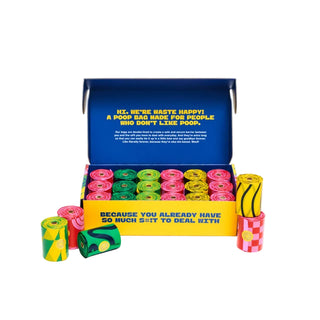
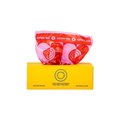
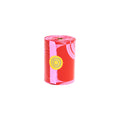
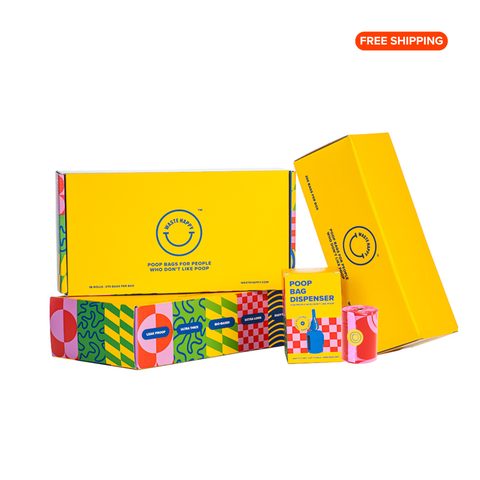
However many dispensers go up, the walk still starts with a bag in your pocket. Take the quiz to see how many bags your dog actually needs each month, or grab a box so you are never stuck without one.
Sources
- New York City Council, Speaker Menin, Council Members, and Animal Rights Advocates Rally in Support of SCOOP Act to Address Dog Waste and Community Cleanliness, May 15, 2026
- New York City Council, NYC Council Approves Year-Round Outdoor Dining, Nation's First Office of Insurance Affordability, and Neighborhood Quality-of-Life Package, August 13, 2026
- New York City Council, Int. 857-A, Local Law 139 of 2026 (bag dispensers)
- New York City Council, Int. 864-A, Local Law 140 of 2026 (dog run compost pilot)
- New York City Council, Int. 872-A, Local Law 141 of 2026 (education campaign)
- New York City Council, Int. 880-A, Local Law 142 of 2026 (park and dog run signs)
- New York City Council, Int. 906-A, Local Law 154 of 2026 (dog waste complaints)
- New York City Council, Legislation (how a bill becomes law)
- New York City Charter, Section 37, Local Laws; Action by Mayor
- New York City Department of Sanitation, Animal Waste
- New York State Senate, Public Health Law Section 1310, Removal of Canine Wastes