







Can You Put Dog Poop in Someone Else's Trash Can? The Law, Trash Day and Manners
Tossing the bag in the nearest curbside can feels harmless. Here is what Ohio law, Milwaukee's code and city trash rules actually say, why trash day matters, and our etiquette for the walk home.
You are three blocks from home with a warm bag in your hand, and there it is: somebody's trash can at the curb, lid up, waiting for pickup. Nobody is watching. It would be so easy.
So, can you? The honest answer has three layers: what the law says, what trash day needs, and what your neighbor will think. They do not always agree.
The short answer
It depends on where you live. Most pick-up rules we have read just say to bin it, not whose bin. But Ohio's littering law and Milwaukee's code limit using someone else's, Seattle's utility says not without permission, and Minneapolis lists other people's carts as illegal dumping. A public litter basket is fine in New York City and Seattle. Otherwise, ask first or carry it home.
Layer 1: the law, which is often silent
We know of no national rule on this, and most local pick-up laws never reach the question. In the city codes behind our dog poop laws by state pages, the rules that mention disposal mostly name a receptacle ("a trash receptacle," "a proper receptacle," "approved containers") and leave it there. Whose receptacle? They do not say.
Silence is not permission, though, and a handful of places do spell it out.
Ohio: you need a reason. Ohio's littering law, Revised Code 3767.32, makes it an offense to knowingly put litter, "without privilege to do so," in a litter receptacle "located on any public property or on any private property not owned by the person," unless an exception applies. The same section defines a litter receptacle as "a dumpster, trash can, trash bin, garbage can, or similar container in which litter is deposited for removal." Your neighbor's curbside can fits that description.
Dog poop is never named. But the law's definition of litter includes "waste" and "anything else of an unsightly or unsanitary nature," and we would not bet on a tied bag of poop falling outside that. That is our reading, not a court's.
The exceptions matter. You are covered if the litter "was generated or located on the property" where the can sits, or if you are told to use the can by someone you reasonably believe has the right to use it. In plain English: ask, and get a yes. A separate carve-out covers a "casual passerby" tossing everyday trash like drink containers and food wrappers. Whether a dog walker's bag counts, the law does not say, and we will not guess.
A violation is a third-degree misdemeanor under section 3767.99, and Ohio caps the fine for that at $500. (For the state's pick-up rules, see our Ohio dog poop laws page.)
Milwaukee: take it home. Milwaukee's animal litter rule, section 78-19-3, tells owners and caretakers to "properly wrap and deposit the fecal matter in an approved waste container as specified in s. 79-4 situated upon his or her own premises." Our literal reading: your own can at home, not a neighbor's, and not a public one either. It is the strictest rule we have found. Our Wisconsin dog poop laws page has the rest of the state.

Seattle and Minneapolis: city pages say no. Seattle Public Utilities says pet waste goes "in your own trash can or a public trash can," and "not in a neighbor's trash can unless you have been given explicit permission," citing city code sections 9.25.082 and 21.36.440. Minneapolis lists putting "household or commercial garbage, litter or other items" into "any garbage cart, dumpster or container on someone else's property" as illegal dumping. That page does not mention dog waste by name, and it does not say whether permission changes anything. The same list also names "public trash containers," so we read it as aimed at dumped household garbage, not a tied bag from a walk.
Public litter baskets: usually the exception. New York City says so outright. The Department of Sanitation's litter basket page says the baskets are "for pedestrians to throw away light trash," and adds: "You may dispose of dog waste, but only if it is within a tied bag." Household and commercial trash is not allowed, and misusing a basket can get you fined up to $350. (Our post on the city's SCOOP Act covers the bag dispensers headed for those baskets.)
So the law runs from silent to strict, depending on your zip code. Before treating any can as fair game, check your city's code (our guide to whether it is illegal to not pick up dog poop explains how) or call 311.
Layer 2: trash day
Even where it is legal, a poop bag in someone else's can is their problem until the truck shows up.
- Flies. A health bulletin from Orange County, California says flies go to dog droppings to eat and to breed, and warns that droppings in the trash "may contain fly eggs." Its advice: double-bag, use a can "with a tight fitting lid," and have trash collected "at least once a week to break the fly breeding cycle."
- Timing. If the can was emptied this morning, your bag may be the only thing in it until the next pickup. On a hot day, that is a long time to sit next to somebody's back door. (Our observation, not a study.)
- Lids. Port St. Lucie, Florida, tells residents "Cart lids must be closed and garbage should be bagged to minimize litter during collection," and suggests double-bagging garbage in summer. A bag balanced on top of a full can keeps that lid propped open. (Our observation.)
- The wrong cart. New York City's Sanitation Department says animal waste does not go in curbside composting or recycling, and Seattle's utility says pet waste stays out of compost, whatever the bag. A poop bag in someone's recycling or compost cart is a mess they did not sign up for. (More on why in what to do with dog poop.) Our bags are not certified compostable and we do not claim they are.
Where the bag can go
The middle column is what the rules above say. The last column is our opinion.
Layer 3: manners (our advice)
This part is our opinion, not law. It is also the part your neighbors care about most.
- Ask once. If your route passes the same house every day, ask. A yes turns a gray area into a favor, and a no saves you from becoming the block's mystery bag dropper.
- Use the public can. Corner litter baskets and park cans are there for this. Tie the bag before it goes in.
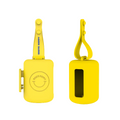
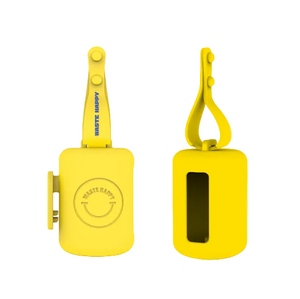
- Carry it home. It is usually a few blocks, and it settles the question in every city. Keep spare bags clipped to the leash (here is how to attach a dispenser) so double-bagging is always an option.
- Double-tie it. Squeeze the air out and knot it twice. Orange County's health officials go further and suggest two bags. Our guide to poop bags that don't smell walks through a knot that holds.
- If you get a yes, mind the timing. The night before pickup beats the morning after.
- Never beside the can. Not on the lid, not by the fence. A bag outside the can is just litter with a knot in it.
The bottom line
Your own can is always safe. A public basket is usually fine. Someone else's can is a maybe at best: restricted in some places, a gamble with the neighbors everywhere, and usually fine with a yes (Milwaukee's text, read literally, is the exception). When in doubt, it rides home with you.
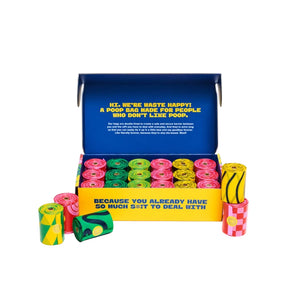
The walk home is easier with a spare bag. Take the quiz to see how many bags your dog actually needs each month, or grab a box so there is always one for the double-bag.
This article is general information, not legal advice. Laws change and vary by city, county and state. For a definitive answer, check your local code or call your city's sanitation department or 311.
Sources
- Ohio Revised Code, Section 3767.32, Littering
- Ohio Revised Code, Section 3767.99 (penalties)
- Ohio Revised Code, Section 2929.28 (misdemeanor fines)
- City of Milwaukee, Code of Ordinances, Chapter 78, Animals (section 78-19-3, Animal Litter Nuisance)
- Seattle Public Utilities, What to Do with Pet Waste
- City of Minneapolis, Illegal Dumping
- New York City Department of Sanitation, Litter and Litter Baskets
- New York City Department of Sanitation, Animal Waste
- County of Orange Health Care Agency, Environmental Health, Disposal of Dog Droppings (informational bulletin, revised 2004)
- City of Port St. Lucie, Office of Solid Waste, Garbage and Trash