


Why Does My Dog Lick Me? What Every Lick Really Means
A lick can be a taste test, a greeting, a bid for attention or a bit of self-soothing. What vets and researchers say, and when to call the vet.
You sat down for four seconds and your dog has already licked your hand, your ankle and, somehow, your phone. It looks like a kiss, and sometimes it is. But a lick can also be your dog tasting you, greeting you or calming themselves down, often all at once.
Here is what vets and researchers actually know about it, and the point where licking stops being sweet and starts being a symptom.
The short answer
Dogs lick people to taste and explore, because licking seems to soothe them, because it is how they were cared for as puppies, to greet and bond, and sometimes because it reliably gets your attention. Everyday licking is usually a mix of these. Sudden or nonstop licking is worth a vet visit.
Your dog is tasting you
VCA Animal Hospitals describes licking as your dog experiencing the world by tasting you, and you are more interesting to taste than you might think. The American Kennel Club points out that human skin is slightly salty, especially after exercise. If the licking gets more enthusiastic after a run, that may be the salt talking.
Then there is everything else on you: the lotion you put on this morning, the sandwich you had at lunch, the coffee you spilled on your hand. The tongue gets a taste of all of it. The nose gets far more.
Your dog can smell how you feel
A dog's nose outclasses ours by an almost silly margin. According to PBS NOVA, dogs have up to 300 million olfactory receptors to our roughly six million, and the part of a dog's brain devoted to analyzing smells is, proportionally, 40 times larger than ours. Dog-cognition researcher Alexandra Horowitz puts it in kitchen terms: you might notice a teaspoon of sugar in your coffee, but a dog could detect a teaspoon of sugar in a million gallons of water.
To a nose like that, your skin and clothes carry a running record of your day, right down to the dog you petted at the park. Your mood is in there too, and that part has peer-reviewed data behind it.
In a 2022 study published in PLOS ONE, researchers at Queen's University Belfast used breath and sweat samples from 36 people, taken before and after a stressful task: counting backward from 9,000 in steps of 17, out loud, for three minutes. Four trained dogs then had to pick the stressed sample out of a lineup. They got it right 93.75% of the time across 720 trials.
A 2018 study in Animal Cognition looked at how dogs react. Labradors and golden retrievers exposed to sweat collected from people in a fearful state showed more stress behaviors and higher heart rates than dogs exposed to sweat from happy people, or to no sweat at all. Your mood has a smell, and dogs respond to it.
Smell can carry health information too. NOVA tells of a cancer-sniffing dog that "insisted" on a spot of skin doctors had already pronounced cancer-free, and a biopsy confirmed melanoma. That is one remarkable case, not a reason to read a diagnosis into an ordinary lick. But it shows how much a dog's nose can pick up.
One caveat, because it matters: these studies tested noses, not tongues. We found no research showing that licking is how dogs pick up on your mood. What the studies do show is how much your dog may already know about you before the tongue ever comes out.
Licking seems to feel good to them
There is a simpler reason, too: licking seems to feel good. According to VCA, studies have shown that when a dog licks, endorphins are released in the brain that make them feel calm, relaxed and secure, followed by a release of dopamine, which is tied to pleasure and motivation.
That may help explain why anxious dogs can lick more, and why vets suggest a lick mat to give the urge somewhere to go. The AKC adds that licking might give a dog a feeling of security and comfort, like the one it had when its mother licked it in the litter. Which brings us to where all of this starts.
It starts on day one
A mother dog licks her puppies from the moment they are born, to clean them and stimulate blood flow. Then comes the part we were always going to mention, given what we sell.
Newborn puppies cannot pee or poop on their own. A review of maternal behavior in the Journal of Small Animal Practice notes that for the first 21 days of life, puppies rely on their mother's licking to trigger urination and defecation. By the end of the third week, they manage without help.
So your dog's earliest experience of being licked was, in part, a bathroom service. Mom handled cleanup for three weeks. After that, as anyone who has kept up with a puppy's poop schedule knows, the job passed to you.
Licking turns social early, too. Puppies lick each other for affection and to settle themselves. As they are weaned, they may lick their mother's mouth to encourage her to bring food back up for them, a habit VCA says is thought to come from wolves. Horowitz, quoted by the AKC, says licking started as food-seeking and has since become a ritualized greeting for many dogs. When your dog meets you at the door with a tongue, that is probably the greeting.
What your dog is probably saying
Most licks have more than one motive behind them. The situation usually tells you which one is in charge.
When licking is too much
Some licking is normal. A sudden increase, or licking that never seems to stop, deserves a closer look. According to the AKC, a dog that licks itself, you or objects excessively might be showing signs of anxiety, boredom or pain, and VCA names anxiety or pain as well. Both suggest a vet check first, to rule out a medical cause.
- Nonstop licking of their own paws or body: the AKC and VCA both say obsessive self-licking can also be a sign of allergies or other health problems.
- Licking floors, walls or furniture: this one can be the stomach, not the mind. In a 2012 study in the Journal of Veterinary Behavior, 14 of 19 dogs that licked surfaces excessively turned out to have gastrointestinal problems, and treating those problems led to significant improvement in a majority of the licking dogs, as dvm360 summarizes.
- Licking that arrives with other changes: vomiting, a dip in appetite or energy, or poop that looks different. That combination is worth a vet visit sooner rather than later.
Is it safe to let your dog lick you?
For most healthy people, a lick on unbroken skin is not a big deal. The CDC notes that most people who have contact with a dog or cat do not become sick. But dog mouths carry germs, including a group called Capnocytophaga, which can make people sick if a dog's saliva gets into an open wound or sore. People with weakened immune systems, including people without a spleen, are at higher risk.
- Keep tongues away from cuts, scrapes and broken skin.
- If anyone in your home has a weakened immune system, keep the dog's tongue away from their face and any broken skin. VCA goes further and recommends avoiding face licks for everyone's health and safety.
- Wash up afterward, especially before you eat.
- Wearing sunscreen? That is its own question, and we covered it in what happens if your dog licks your sunscreen.
If you would rather skip the kisses
You do not have to put up with it, and you should not punish it either, since licking is normal dog behavior. The fix is to give the urge somewhere else to go.
- Redirect, every time. Offer a puzzle toy or a game of fetch the moment the licking starts. Consistency is what teaches it.
- Do not reward it by accident. Laughing, talking, even pushing your dog away is still attention. VCA notes that any reaction can encourage more licking.
- Ask for a sit. Reward the sit instead, so your dog earns the attention the licking was after.
- Use a lick mat. Spread a little plain yogurt or peanut butter on one. Check the peanut butter label for xylitol, which is dangerous to dogs.
- Burn some energy. The AKC notes that excess energy can lead to over-licking, so a longer walk often means fewer licks.
So, what does the lick mean?
A lick is rarely one thing. It can be a taste test, a greeting, a bid for attention and a bit of self-soothing, rooted in the first care your dog ever got. Mostly, it means you are one of theirs.
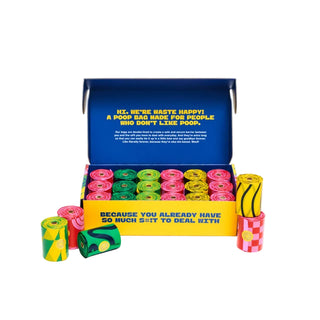
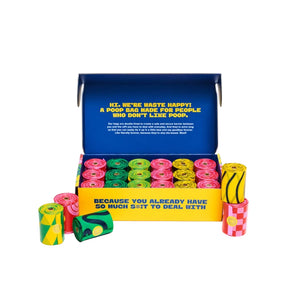
Their mother handled the cleanup for the first three weeks. Everything since has been your job. Take the quiz to see how many bags your dog actually needs each month, or grab a box so you are never caught short on a walk.
This article is general information, not veterinary advice. If your dog's licking is new, constant, or comes with other changes, talk to your vet.
Sources
- American Kennel Club, Why Does My Dog Lick Me? Why Do Dogs Lick People?
- VCA Animal Hospitals, Why Do Dogs Lick Humans?
- PBS NOVA, Dogs' Dazzling Sense of Smell
- Wilson, Campbell, Petzel and Reeve, Dogs Can Discriminate Between Human Baseline and Psychological Stress Condition Odours, PLOS ONE, 2022
- D'Aniello, Semin, Alterisio, Aria and Scandurra, Interspecies Transmission of Emotional Information via Chemosignals: From Humans to Dogs, Animal Cognition, 2018
- Santos, Beck and Fontbonne, A Review of Maternal Behaviour in Dogs and Potential Areas for Further Research, Journal of Small Animal Practice, 2020
- dvm360, Compulsive Disorders: Have You Considered GI Involvement?, summarizing Bécuwe-Bonnet et al., Gastrointestinal Disorders in Dogs with Excessive Licking of Surfaces, Journal of Veterinary Behavior, 2012
- Centers for Disease Control and Prevention, About Capnocytophaga