


Can Dogs See Fall Colors? What Your Dog Sees on an Autumn Walk
Dogs see blue and yellow well and reds as browns. What an autumn walk looks like to your dog, the fall hazards to watch for, and the leaf pile problem.
The leaves are turning, the air smells like somebody's fireplace, and your dog would like to go out now, please. Here is the part most people do not know: your dog sees fall very differently than you do. And in one way, it may be the best-looking season they get all year.
The short answer
Partly. Dogs see blue and yellow well, but reds and greens come through as browns and grays. So golden leaves and a blue sky look vivid to your dog, while a red maple fades into the background. Take the walk anyway. The nose is having the best season of all.
How dogs actually see color
Dogs are not color blind in the black-and-white sense. That idea is a myth. They have color vision, just less of it than we do.
Human eyes have three types of color-detecting cones. In a 1989 study in Visual Neuroscience, researchers tested the color vision of three dogs and found just two classes of cone, one tuned to blue-violet light and one to yellow-green. That makes dogs dichromats.
The American Kennel Club puts it in everyday terms: dogs can make out yellow and blue and combinations of the two, and scientists now compare their color vision to a person with red-green color blindness. A red cushion probably reads as a dark brown blob. That lush green lawn you mow every Saturday? To your dog, it probably looks like a field of dead hay.
What an autumn walk looks like to your dog
Now picture the same walk in October.
Put those together and you get a fair guess at why fall walks hit differently. In summer, a dog's world is mostly the grayish-brown of green things they cannot quite see. In fall, a lot of the landscape shifts into yellow, one of the two colors they see best, under a sky in the other one. Nobody has measured how a dog feels about foliage, so treat this as our reasoning rather than science. But if your dog seems extra interested in the October walk, the colors may be part of it.
One practical upshot: if you play fetch in the leaves, a blue or yellow ball is likely much easier for your dog to find than a red one, which can disappear into a brown leaf pile.
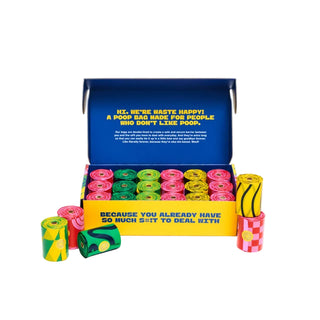
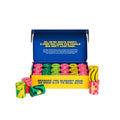
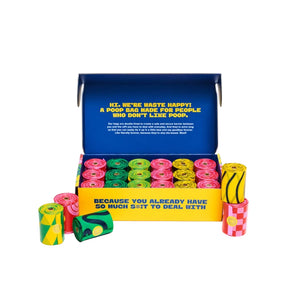
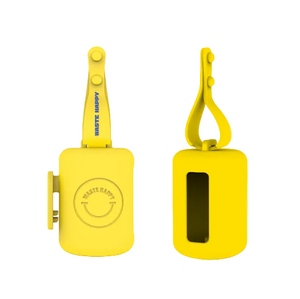
We would love to tell you our yellow boxes and blue logo were designed with dog vision in mind. They were not. But your dog can see them, which is more than we can say for most of the pet aisle.
Meanwhile, the nose is having its best season
Color is the small part of the story. According to PBS NOVA, dogs have up to 300 million olfactory receptors to our roughly six million. Fall gives that nose a whole new feed: fresh leaf litter, fallen fruit, nuts, and everything the local squirrels are busy burying. If your dog has turned every walk into a slow, deeply serious investigation, that is why. Let them sniff. For a dog, that is the good part. (We dug into what that nose picks up from you in why does my dog lick me.)
Fall walk hazards worth knowing
The same leaf litter that makes fall walks so interesting also hides a few things worth keeping out of your dog's mouth.
- Wild mushrooms. They tend to pop up in wet, warm weather, which can be any time in spring or fall, and the ASPCA notes that toxicity ranges from no big deal to deadly. You cannot tell which is which by looking, so treat any mushroom your dog eats as a call to your vet.
- Acorns. An ASPCA veterinary toxicologist, writing for Vetstreet, notes that acorns contain a toxin called gallotannin that can cause mild to moderate stomach upset, and that whole acorns can lodge in the gut and cause a blockage.
- Moldy fallen nuts. The same source warns that nuts can become poisonous as they sit on the ground and grow mold, which can cause tremors and seizures.
- Ticks. Cooler weather does not mean tick season is over. Penn State Extension notes that adult blacklegged ticks, also called deer ticks, are out in October and November, and recommends checking pets for ticks after time outdoors.
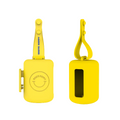
- The dark. When daylight saving time ends in early November in most of the country, the after-work walk moves into the dark overnight. A reflective leash or a clip-on light helps drivers see you both.
If your dog does eat something questionable, call your vet or a poison line rather than waiting to see what happens.
- ASPCA Animal Poison Control Center: (888) 426-4435
- Pet Poison Helpline: (855) 764-7661
The leaf pile problem
Here is the fall challenge nobody puts on a postcard. Your dog cannot see red. You cannot see poop in a pile of brown leaves.
Brown on brown is the best camouflage there is, and plenty of perfectly responsible owners have looked away for one second and lost the spot entirely. A few things help:
- Watch the squat. Keep your eyes on the exact spot until you are standing over it. Pick a landmark, like a tree root or a rock, before you reach for a bag.
- Grab a few leaves with it. They come up in the bag together, and nobody is checking.
- Leaves are not cleanup. Kicking a few over it does not count, and in most places it is still your job, leaves or no leaves. We covered the rules in is it illegal to not pick up dog poop.
- Bring a light after dark. Finding it in leaves is hard. Finding it in leaves at 5:45 pm in November is harder.
So, take the walk
Your dog will not get the red maples. They will get gold leaves, a blue sky, and the most interesting smells of the year. That is a pretty good deal, and it only lasts a few weeks.
Already planning for colder walks? Our guide to poop bags for winter and cold weather picks up where this one leaves off. And before the leaves come down, take the quiz to see how many bags your dog actually needs each month, or grab a box so you are never caught short in the leaf pile.
This article is general information, not veterinary advice. If your dog eats a mushroom, acorns, or anything else you are unsure about, call your vet or one of the poison lines above.
Sources
- American Kennel Club, Can Dogs See Color?
- Neitz, Geist and Jacobs, Color Vision in the Dog, Visual Neuroscience, 1989
- PBS NOVA, Dogs' Dazzling Sense of Smell
- ASPCApro, Mushroom Poisoning in Dogs
- Vetstreet, 7 Fall Plant and Garden Dangers for Pets, by an ASPCA Animal Poison Control veterinary toxicologist
- Penn State Extension, Preventing Tick Bites in the Fall