


Nobody knows for sure why dogs roll in poop, but a 1986 wolf study offers clues. The theories ranked by evidence, how to stop the roll, and how to bathe your dog without hurting eyes or ears.
The walk is going great. Then your dog stops, sniffs one patch of grass for a suspiciously long time, dips a shoulder and goes over, legs pedaling the air, happier than you have ever made them. You know before you smell it.
Here is what science knows (not much), how to stop the roll, and how to clean up after one.
The short answer
Nobody knows for sure. The main theories are that dogs roll to hide their own scent, to carry interesting smells back to their group, or because they love a strong smell. A 1986 wolf study found perfume and motor oil drew the most rolling. Prevention means a leash, "leave it" and a reliable recall.
What the research actually says
The American Kennel Club says scientists do not have a definitive answer, and VCA Animal Hospitals admits that "since we can't ask our dogs, we can't know for sure." We could not find a controlled study of poop rolling in pet dogs.
So researchers look to wolves. The experiment the AKC cites, published in 1986 in the Canadian Journal of Zoology, offered two groups of wolves (15 animals in all) eight smells that were new to them. Here is what they rubbed and rolled in (the paper calls it scent rubbing):
- Most: perfume and motor oil.
- Second: cougar poop and black bear poop.
- Barely: salt pork, which got a single rub from one wolf. Tuna oil got none.
- Not at all: sheep poop and horse poop.
Rolling tended to fade slightly over repeat tests, more so for perfume and motor oil. The authors suggested wolves may roll in smells that are unusual for their surroundings, familiar smells that have somehow changed, or smells they strongly like or dislike.
The caveats: wolves are not dogs, 15 is a small group, and the study tested which smells wolves rolled in, not why.
The theories, and how much evidence each has
Evidence ratings are our summary of the sources.
Why the doubt about disguise? Rachel Lane, a certified behavior consultant quoted by the AKC, notes that wolves are not usually ambush hunters and that dogs as a species mostly scavenge. In her words: "A scavenger has no need to disguise its own smell because they are not ambushing or trailing prey."
The news idea has some indirect support, from a different animal. In a 2002 study, researchers put odors on the coats of captive spotted hyenas. Hyenas wearing carrion got more investigation and grooming from their pen mates; hyenas wearing camphor had their usual greeting cut short. Hyenas are not dogs, but a borrowed smell changed how the group reacted.
On pure joy, Lane says dogs that come across a new, strong smell "might be thrilled to have found something so fun to interact with."
And attention? We could not find a vet or behavior source that lists it for rolling. The AKC does list getting a reaction out of you as one possible reason dogs eat their own poop, but that is a different habit. Our hunch: if every roll kicks off a game of chase, some dogs may decide rolling is worth it. A guess, not a finding.
How to stop the roll before it starts
- Leash up in the usual suspects. The AKC names farms, wooded trails and places wildlife frequents as strong-smell territory. A leash there turns a full roll into a near miss. (Here is our guide to poop bags for hiking.)
- Learn your dog's tell. The AKC suggests watching body language so you can step in early. In our experience (not a study), the giveaway is a long, fixed sniff, then a dipped head or shoulder.
- Train "leave it" and a solid recall. Lane recommends both: "leave it" works from a distance, and a good recall pulls your dog away. VCA suggests practicing often, with a healthy treat as the payoff, so the cue holds up when it counts.
- Stay calm if you are too late. The AKC says to lead your dog away from the smell calmly and clip the leash on if needed. Calm also avoids a chase game (our reasoning).
- Pick up. A pile that is already in a bag cannot be rolled in (our logic, not a study). The CDC says to pick up dog poop even in your own yard. Other dogs' leftovers are the hard part, one more reason we wish everyone picked up after their dog.
How to clean a dog who rolled in poop
Once your dog is coated, the AKC says a thorough bath is probably unavoidable. Here is how.
- Protect your hands. The CDC recommends disposable gloves for poop messes in the house, and we would wear them here too. Our habit: use a poop bag like a mitten to lift off the worst of it outside first.
- Use dog shampoo and warm water, not hot. The AKC says shampoo made for people has the wrong pH for a dog's skin. VCA gives the numbers: human skin runs more acidic (pH 5.2 to 6.2) than dog skin (6.2 to 7.5), and the mismatch can strip protective oils from the coat. The ASPCA notes human shampoo is not toxic to pets, though some may contain fragrances or other ingredients that can irritate the skin.
- Work it in everywhere. Lather down to the skin. Include the belly, legs, paws and under the neck and tail, per the AKC, and give the back and shoulders extra time, since that is where dogs usually roll.
- Keep shampoo out of the eyes. The ASPCA suggests skipping shampoo on the head altogether and cleaning the face with a wet washcloth. It also suggests getting a sterile eye lubricant from your vet to protect the eyes during the bath.
- Keep water out of the ears. The ASPCA and AKC both suggest cotton balls in the ears. The ASPCA also says not to spray or pour water straight into the ears, eyes or nose, and never to push anything into the ear canal, whose shape makes trapped water hard to get out and ear infections more likely. Dry the ears well afterward.
- Rinse, then rinse again. The AKC says to get out every trace of shampoo.
- Dry them well. Towels first. If you use a hair dryer, the AKC says to avoid the hottest setting, hold it at least a foot away, and keep your dog somewhere warm until fully dry.
- Wash your own hands. The CDC says to wash with soap and running water after contact with dog poop, even if you used a bag.
What not to use: your own shampoo, a hot dryer up close, or anything poked into the ear canal.
Is rolling in poop dangerous?
Lane says the behavior itself is usually harmless. But the AKC notes that what your dog rolled in may carry bacteria, parasites or other contaminants, which is why the bath matters. According to the Companion Animal Parasite Council (CAPC):
- Giardia cysts can infect as soon as they are passed in poop, and self-grooming is one way dogs pick them up. A dog licking a poop-coated coat fits that picture. That connection is ours, not CAPC's.
- Roundworm eggs mostly need two to four weeks outside to become infective. By then the poop has often broken down, so there may be nothing to see, and the eggs can survive for years. Dogs get infected by swallowing them.
CAPC counts leash laws and prompt poop pickup among the key ways to prevent roundworms, and VCA recommends keeping your dog current on parasite preventives. Spot something wriggling later? Here is what worms in dog poop look like.
The bottom line
Your dog is not being gross to annoy you. Probably. Whether the roll is a disguise, a news report or pure joy, the fix is the same: leash up in the stinky places, train "leave it," and keep poop in bags where it belongs.
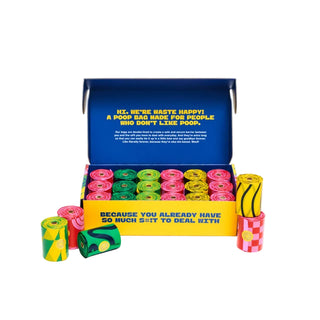
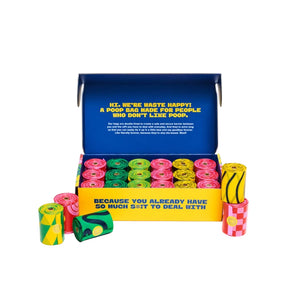
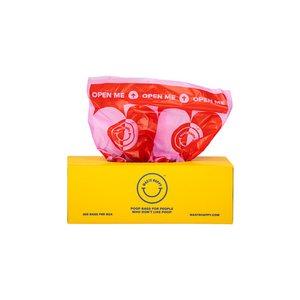
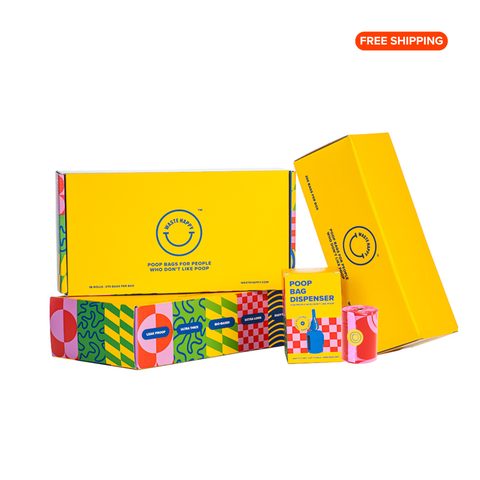
Every pickup takes a bag. Take the quiz to see how many your dog goes through each month, or grab a box so there is always one on the leash.
This article is general information, not veterinary advice. If you see worms in your dog's poop or your dog seems unwell after rolling in something, talk to your vet.
Sources
- Ryon J, Fentress JC, Harrington FH, Bragdon S. Scent rubbing in wolves (Canis lupus): the effect of novelty. Canadian Journal of Zoology, 1986; 64(3): 573-577
- Drea CM, Vignieri SN, Cunningham SB, Glickman SE. Responses to olfactory stimuli in spotted hyenas (Crocuta crocuta): I. Investigation of environmental odors and the function of rolling. Journal of Comparative Psychology, 2002; 116(4): 331-341
- American Kennel Club, Why Do Dogs Roll in Smelly Stuff?
- VCA Animal Hospitals, Why Does My Dog Roll in Gross Things?
- American Kennel Club, Why Dogs Eat Poop and How to Stop It
- American Kennel Club, It's Bath Time! Towels, Brushes, Dog Shampoo, and More
- VCA Animal Hospitals, True or False: It's Okay to Use Human Shampoos on Pets
- ASPCA, Dog Grooming Tips
- Centers for Disease Control and Prevention, Healthy Pets, Healthy People: Dogs
- Companion Animal Parasite Council, Giardia
- Companion Animal Parasite Council, Ascarid (Roundworm)