










Worms in Dog Poop: What You Can See, What You Can't, and What to Do
Found worms in your dog's poop? What roundworms and tapeworm segments look like, the parasites you cannot see, the CAPC puppy deworming schedule, and how to bag a sample for your vet.
Kelly Ripa and Mark Consuelos had to wait a little longer than planned to bring home Javi, the rescue puppy they met on their show, Live with Kelly and Mark. The holdup, TV Insider and Hello! reported in mid-October, was a parasite that was being treated. The couple did not say which kind, so we will not guess. (Happy ending: Hello! has since reported that Javi is home.)
It is a useful reminder that parasites are about as ordinary as puppy problems get, even for puppies who get great care. The Companion Animal Parasite Council (CAPC), an independent nonprofit run by veterinarians and parasitologists, says some studies have found that virtually all puppies are born infected with roundworms.
So if you just found something in your dog's poop that should not be there, take a breath. Here is what you can see, what you usually cannot, and what to do next.
The short answer
Pale, spaghetti-like worms are most likely roundworms, and small, rice-like segments, sometimes moving, are most likely tapeworm. Hookworms, whipworms, giardia and coccidia usually cannot be seen at all, so finding them takes a fecal test. Bag a fresh sample, call your vet, and pick up poop right away. Parasites are common in puppies, and treatable.
What are you looking at?
Start here. This is a rough guide, not a diagnosis. Only your vet, usually with a fecal test, can say for sure.
The two you can see: spaghetti and rice
Roundworms look like spaghetti. The American Kennel Club describes "large, pale-colored, spaghetti-like worms," sometimes still moving. The Merck Veterinary Manual says roundworms are common in dogs, especially puppies, and can be passed in poop or vomit. Infected young dogs may look potbellied, with a dull coat, though plenty of dogs show no signs at all.
Tapeworm segments look like rice. The worm stays inside and sheds segments. The CDC says each one is about the size of a grain of rice, and you can sometimes see them crawling near your dog's rear end or on fresh poop. Dried out, they look like small, hard, yellowish grains stuck to the fur. CAPC says they can turn up on bedding, too.
The tapeworm you are most likely to spot, according to VCA Animal Hospitals, is the flea tapeworm. Dogs get it by swallowing an infected flea, often while grooming, the CDC says. That is why the Merck manual calls flea control "the critical preventive step even for indoor dogs."
One catch: the CDC says routine fecal exams usually miss flea tapeworm eggs, and CAPC says the segments are not spread evenly through the poop. So tell your vet exactly what you saw. And if you see dead worms right after a deworming, VCA says that can happen. If you keep seeing worms, VCA says to call your vet right away.
The ones you usually can't see
Most intestinal parasites cannot be seen with the naked eye, VCA says. Hookworms and whipworms usually pass only microscopic eggs, and giardia and coccidia are protozoans, single-celled parasites far too small to spot. CAPC notes that any of them can show up in a dog that seems perfectly healthy.

- Hookworms. Less than an inch long, they latch onto the small intestine and feed on blood. In puppies, CAPC lists pale gums, poor growth and dark, tarry diarrhea among the signs, and a heavy infection can be fatal without immediate treatment. (More on black, tarry poop.)
- Whipworms. Many infections cause no signs, CAPC says, but some cause diarrhea, often with streaks of mucus and bright red blood (more on mucus in dog poop). They shed eggs on and off, so one clean test does not always rule them out.
- Giardia. Most infections cause no signs, according to CAPC. When they do, expect diarrhea that may be sudden, come and go, or linger, sometimes with gas, vomiting or mucus, and extra-smelly poop. It is more common in dogs from shelters, kennels and breeding facilities, and in dog park regulars. It is easy to miss, so your vet may test more than one sample.
- Coccidia. More common in young dogs. CAPC says it can cause diarrhea with weight loss and dehydration, and that stress, including the move to a new home, can make it worse. Dogs can also carry it with no signs.
Sometimes the only clue is the poop itself. Our dog poop color guide covers odd colors, and our runny poop guide covers when to call the vet about diarrhea. The CDC's rule of thumb: diarrhea that is not going away needs a vet, because it can lead to dehydration.
Puppies: deworming starts at 2 weeks
Puppies often get parasites before they ever leave their mother. The CDC says puppies usually pick up roundworms from their mother before birth or while nursing. Hookworms pass through her milk, too, which CAPC says keeps hookworm infection common in puppies "even in pets that are well cared for and routinely treated for intestinal parasites." In US surveys, more than 30% of dogs younger than 6 months were shedding roundworm eggs.
So deworming starts early. CAPC's general guidelines put it this way: "Administer anthelmintic treatment to puppies and kittens starting at 2 weeks of age and repeating every 2 weeks until regular broad-spectrum parasite control begins."
In plain English: a dewormer (that is what an anthelmintic is) at 2 weeks old, then every 2 weeks, until your puppy starts the year-round parasite protection your vet recommends. If that is not in the plan, CAPC's fallback is "every 2 weeks until 2 months of age, monthly until 6 months of age, and quarterly thereafter." CAPC also frames early deworming as a way to keep eggs from contaminating the environment.
CAPC also recommends fecal tests "at least four times during the first year of life," and at least twice a year for healthy adults. Puppies poop a lot (here is our puppy poop schedule), so you will have plenty of chances.
Just adopted? Ask the rescue or shelter for the dates of any dewormings and fecal tests, and bring them to your first vet visit. That tip is ours, not CAPC's.
Found something? Bag a sample, and don't panic
Worms look alarming, but they are a fixable problem. VCA's reassurance: with your vet's help, worms are easy to deal with, and the type of worm decides the treatment. So the first job is a sample.
- Bag it. AKC chief veterinarian Dr. Jerry Klein says you can collect a sample "as you would when picking up after your dog using a poop bag." VCA asks for a piece about an inch long, as free of grass and gravel as you can get it.
- Seal it and get it there fresh. VCA's rule: seal it in a clean, dry jar or zip-top bag and get it to the clinic within six hours, or 24 hours if you keep it in the fridge. If it does go in the fridge, double bag it and keep it away from food (our tip).
- Report what you saw. Spaghetti or rice? Moving or not? If you can, bag the worm or segment with the sample. A quick photo helps, too (our tip).
- Wash your hands. The CDC says to wash up after contact with dog poop, "even if you use a bag."
Do not wait if a puppy has pale gums or black, tarry diarrhea. CAPC lists both among the signs of a heavy hookworm infection, which can be fatal in young puppies without immediate treatment. Call your vet right away.
Can people catch them?
Some can. That is why dog poop is everyone's business.
- Roundworms: yes. People get infected by accidentally swallowing dirt or food contaminated with the eggs, the CDC says. Many never get sick, but according to the CDC, severe cases are more likely in young children who play in or eat contaminated dirt, and the infection can even cause vision loss.
- Hookworms: yes, through the skin. The CDC says larvae can burrow into bare skin when people walk barefoot or sit on soil or sand contaminated with animal poop, causing severe itching and raised red tracks. Most people recover without treatment in about 5 to 6 weeks.
- Flea tapeworm: occasionally. Not from the poop itself: people get it the same way dogs do, by swallowing an infected flea. The CDC says most reported cases are in children, treatment is simple, and flea control is the best prevention.
- Echinococcus, a rarer tapeworm: rarely. Dogs usually pick it up by hunting or scavenging, and CAPC calls the overall human risk in North America low.
- Giardia: possible, but unlikely. The CDC says the type that makes people sick is usually not the type that makes dogs sick.
- Whipworms and coccidia: not considered a human risk, according to CAPC.
Why fast pickup protects parks, yards and kids
Here is the sneaky part. Fresh roundworm eggs are not infective yet. The CDC says they need about 2 to 4 weeks in the environment to develop, then can survive in soil for months, or even years, under the right conditions. By then, CAPC notes, the poop has often broken down, so nothing on the ground looks contaminated.
The pile is gone. The eggs are not. (More in how long dog poop takes to decompose.)
Other parasites move faster. CAPC says giardia cysts are infective the moment they are passed, hookworm larvae can be ready in about 2 to 9 days, and coccidia become infective quickly, too. So the best time to pick up is right away, which is exactly CAPC's advice: "Pick up feces immediately when walking a dog in a public area and from the yard on a daily basis."
It matters most where kids play. CAPC says roundworm eggs are commonly found in soil from playgrounds and parks, recommends covering sandboxes, and notes that hookworm skin infections in children have been traced to sandboxes. The CDC is blunt: pick up dog poop "even in your own yard, and especially in areas where children may play."
Then bag it and bin it, as the CDC advises. Here is what to do with dog poop once it is bagged, and if your dog likes to snack on it first, here is why dogs eat poop and how to stop it.
The bottom line
Spaghetti and rice, you can see. Hookworms, whipworms, giardia and coccidia, you mostly cannot. Either way, the plan is the same: bag a sample, call your vet, keep puppies on their deworming schedule, and pick up every single time.
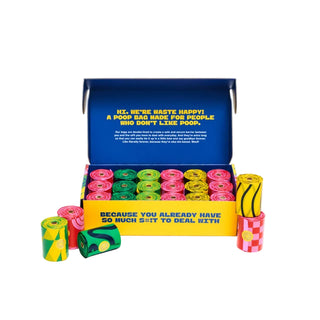
Take the quiz to see how many bags your dog goes through in a month, or stock up so there is always one for the walk and one for the vet.
This article is general information, not veterinary advice. If you find worms or rice-like segments in your dog's poop, or your dog has diarrhea that is not going away or black, tarry or bloody stool, or a puppy has pale gums, call your vet.
Sources
- TV Insider, Kelly Ripa & Mark Consuelos' Puppy Adoption Delayed Due to Health Issue, October 19, 2026
- Hello!, Kelly Ripa and Mark Consuelos Reveal Newest Family Pet's 'Health Issue', October 19, 2026
- Hello!, Kelly Ripa and Mark Consuelos Share First Photos of New Family Member After Health Scare, October 21, 2026
- Companion Animal Parasite Council, General Guidelines for Dogs and Cats
- Companion Animal Parasite Council, Ascarid (roundworms)
- Companion Animal Parasite Council, Hookworms
- Companion Animal Parasite Council, Trichuris vulpis (whipworms)
- Companion Animal Parasite Council, Dipylidium caninum (flea tapeworm)
- Companion Animal Parasite Council, Echinococcus spp.
- Companion Animal Parasite Council, Giardia
- Companion Animal Parasite Council, Coccidia
- Centers for Disease Control and Prevention, How Toxocariasis Spreads
- Centers for Disease Control and Prevention, About Toxocariasis
- Centers for Disease Control and Prevention, About Zoonotic Hookworm
- Centers for Disease Control and Prevention, About Dog or Cat Tapeworm Infection
- Centers for Disease Control and Prevention, About Giardia and Pets
- Centers for Disease Control and Prevention, Healthy Pets, Healthy People: Dogs
- Merck Veterinary Manual, Gastrointestinal Parasites of Dogs (pet owner version)
- American Kennel Club, Roundworms in Dogs: Symptoms, Treatment, and Prevention
- American Kennel Club, Worms in Dogs: Signs, Symptoms, Treatments
- VCA Animal Hospitals, What to Do If You See Worms in Your Dog's Poop
- VCA Animal Hospitals, Importance of Fecal Tests in Dogs & Cats