








The clocks fall back Sunday and the evening walk goes dark. What drivers can actually see at night, why reflective strips on moving joints beat a vest, and a checklist for you and your dog.
This weekend has two dark walks on the calendar. Saturday is Halloween, a night walk with crowds (our Halloween safety guide covers that one). Then on Sunday, November 1, the clocks fall back an hour and sunset jumps an hour earlier by the clock. If you walk your dog at dusk this week, you will be walking in the dark next week.
And you are probably harder for drivers to see than you think. Here is what the research says they can actually see at night, and how to make sure it is you and your dog.
The short answer
Less than you think. In 2024, 76% of US pedestrian deaths happened in the dark. In nighttime tests, drivers spotted walkers with reflective strips on their moving joints much sooner than walkers in just a reflective vest. So light up you and your dog, wear reflective bands on your ankles and wrists, and never assume a driver sees you.
Your evening walk is moving into the dark
Daylight saving time ends at 2 a.m. local time on Sunday, November 1, 2026, according to the National Institute of Standards and Technology (NIST). Hawaii, most of Arizona and several US territories skip the change. If your dog's dinner and walk times still need shifting, here is our one-week plan.
The dark matters. In 2024, 7,080 pedestrians died in US traffic crashes, and 76% of those deaths happened in the dark, according to the National Highway Traffic Safety Administration (NHTSA). In the fall months, the biggest share, 29%, came between 6 and 8:59 p.m. If that is when you walk your dog, that is your window.
It got worse over the 2010s. A 2025 National Academies report, Improving Pedestrian Safety at Night, found that US pedestrian deaths rose 51% from 2010 to 2020, while the share in darkness grew from 71% to 77%. Late autumn and winter had the most nighttime pedestrian deaths.
Two caveats. We are not claiming the clock change itself causes crashes; this post is about the dark, not the clock. And darkness is not the only factor: the report also points to speed, wide multilane roads and alcohol. On a dog walk, though, what you control is how visible you are and where you walk.
What drivers can actually see
Being visible and being recognized are not the same thing. A 2016 review by researchers including Richard Tyrrell of Clemson University and Joanne Wood of Queensland University of Technology (QUT), whose labs ran the studies below, says a pedestrian at night should be more than "detectable as an ambiguous object." They should catch a driver's attention and be "readily perceivable as pedestrians." Here is what changed the results in their tests, most of them on closed roads at night:
See the pattern? Reflective strips on the parts that move, like ankles, knees and wrists, beat the same material on your chest. Researchers call it biological motion, or biomotion: showing how a body moves helps a driver see a person, not a mystery reflector. In the 2017 study, drivers' eyes found the walker with joint markers in 1.1 seconds, against 3.5 seconds for the vest alone. The review calls the advantage of marking the extremities established, and the National Academies report agrees: pedestrians are more visible in reflective clothing, "particularly when the clothing highlights biological motion (i.e., moving arms and legs)."
One caveat: most of these were small tests with 14 to 24 drivers each, so treat the distances as illustrations, not promises.

You are less visible than you think
Both sides of the windshield get this wrong. Pedestrians overestimate how visible they are at night, the review notes, and underrate how much it depends on what they wear. Drivers, says the National Academies report, "routinely underestimate how compromised their vision is at night."
So walk like nobody can see you. NHTSA's advice: "Never assume a driver sees you," and "make eye contact with drivers as they approach." In the National Academies focus groups, people said they already "generally behave as if drivers do not see them at night." Good instinct.
Gear helps. It is not a force field.
The National Academies report is blunt. Campaigns urging pedestrians to be more visible "have not been shown to be effective," it says, and they put "an undue and often unrealistic burden on pedestrians rather than addressing vehicle speed, the root of the safety problem."
Fair point: a reflective leash does not slow anyone down. But you are the one out there tonight, so do both: wear the gear and choose the route. The report flags higher-speed, multilane roads as riskier at night, and says street lighting helps but is not enough on its own. When you can, pick the lit street with a sidewalk over the fast road with a shoulder.
You would be in good company, too. In the report's focus groups, people who sometimes wore reflective or bright gear named two occasions: exercise walks and dog walks.
What about your dog?
We could not find a single study of how well drivers see dogs at night, so this part is our inference, not a finding.
If moving reflective points help drivers recognize a person, the same logic says to put lights and reflective gear on your dog, including the parts that move: a reflective harness, a reflective leash that swings with every step and, if your dog does not mind, anything reflective near the legs. And since a bike light did not help drivers recognize cyclists, do not count on one blinking collar light to do the whole job. We would also bet that a black Lab on a dark street does about as well as the walker in black clothing. As far as we can find, nobody has measured that either.
The American Kennel Club's leash guide calls a leash with reflective material "a safer option" for night walks near a road, and warns: "Thin retractable cords are difficult to see in the dark." In the AKC's harness guide, veterinarian Dr. Amy Attas suggests sticking strips of high-visibility reflective tape on a harness that has none, and the guide notes that reflective harnesses with LED lights "can help increase your dog's visibility on nighttime or early morning walks."
The dark walk checklist
- A light for you and one for your dog. NHTSA says to "wear reflective materials or use a flashlight at night." For your dog, a clip-on light or an LED harness. The light is a start, not the whole job.
- A reflective leash or harness. Ideally both. Leave the thin retractable cord at home after dark.
- Reflective bands on your ankles and wrists. In the 2008 open-road test, markers on just the ankles and wrists were still spotted from "surprisingly long" distances. Already own a reflective vest? Keep it and add markers at the joints, the combination that won in the 2017 study.
- Face traffic where there is no sidewalk. NHTSA says to use the sidewalk or path when there is one and, if not, "walk on the shoulder, facing traffic." Our rule: keep your dog on the side away from the cars, on a short leash. The AKC also points out that a second handle near the clip helps in traffic.
- Your phone flashlight, for finding the poop. Use it as a flashlight, not a screen: NHTSA also warns walkers about phone distraction. A headlamp is better still, since it leaves both hands free. More in the Dark walks section of our winter poop bag guide.
- Watch the squat. Line the spot up with something fixed, like a mailbox or a tree, before you walk over. Brown leaves make it harder (see the leaf pile problem in can dogs see fall colors).
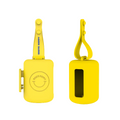
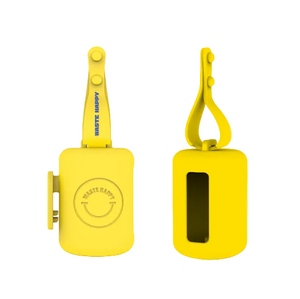
- Keep the bag dispenser on the leash. In the dark, you want to find a bag by feel, not by digging through three pockets. Clip it in the top third of the leash, near your hand (here is how).
See and be seen
Light up both of you, put the reflective stuff where you move, pick the lit street and walk like nobody can see you. Then enjoy it. The sniffing does not care what time sunset is. For the rest of the routine, here are our 10 dog walking tips.
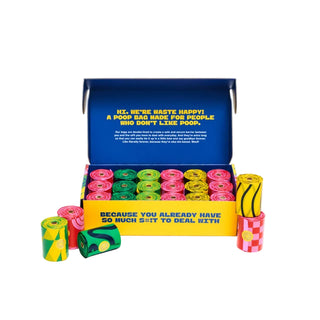
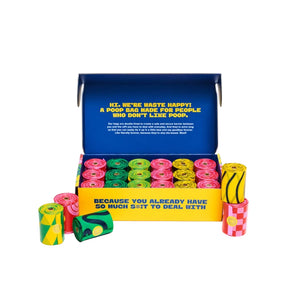
Darker walks still end with a bag in your hand. Take the quiz to see how many bags your dog actually needs each month, or grab a box so the dispenser on your leash is never empty in the dark.
Sources
- National Institute of Standards and Technology, Daylight Saving Time Rules
- National Highway Traffic Safety Administration, Pedestrians: 2024 Data, Traffic Safety Facts, DOT HS 813 818, June 2026
- National Academies of Sciences, Engineering, and Medicine, Improving Pedestrian Safety at Night, NCHRP Web-Only Document 430, 2025
- Tyrrell, Wood, Owens, Whetsel Borzendowski and Stafford Sewall, The Conspicuity of Pedestrians at Night: A Review, Clinical and Experimental Optometry, 2016
- Wood, Tyrrell and Carberry, Limitations in Drivers' Ability to Recognize Pedestrians at Night, Human Factors, 2005
- Balk, Tyrrell, Brooks and Carpenter, Highlighting Human Form and Motion Information Enhances the Conspicuity of Pedestrians at Night, Perception, 2008
- Wood, Tyrrell, Lacherez and Black, Night-Time Pedestrian Conspicuity: Effects of Clothing on Drivers' Eye Movements, Ophthalmic and Physiological Optics, 2017
- Wood, Tyrrell, Marszalek, Lacherez, Carberry and Chu, Using Reflective Clothing to Enhance the Conspicuity of Bicyclists at Night, Accident Analysis & Prevention, 2012
- American Kennel Club, Dog Leashes 101: These Leashes Were Made for Walking
- American Kennel Club, Choosing the Right Harness for Your Dog