








Why Do Dogs Kick the Grass After They Poop? What the Scratch Is Saying
That backward kick after your dog poops is not cleanup. What vets and behavior researchers think the scratch is saying, whether it is a male thing, and when kicking or scooting needs a vet.
Your dog finishes, takes a step forward, and then fires off two or three mighty backward kicks. Grass, dirt and the odd wood chip go flying. You, naturally, are standing right in the blast zone.
It looks like a cat tidying up. It is not. Here is what vets and behavior researchers think the kick is actually for, and when it is worth a closer look.
The short answer
Mostly, it is a message, not a cleanup. Glands on the paw pads and between the toes leave scent, and the scraped-up ground adds a mark other dogs can see. Researchers still cannot say exactly what the message means. Kicking is normal. Sore pads, scooting or straining are worth a call to your vet.
Not cleanup: a calling card
Nicholas Dodman, a veterinary behaviorist and professor emeritus at Tufts University's Cummings School of Veterinary Medicine, took on the cat theory in a piece first published in the AKC's Family Dog magazine. Plenty of owners assume the dog is covering its mess, he wrote, and "this is not true." The dog is "symbolically marking the territory."
His summary of the poop-then-scrape routine is our favorite line on the subject: "Zorro conclusively was here, according to what you are seeing and smelling." That sentence holds both leading explanations: something to smell and something to see. VCA Animal Hospitals agrees the kick has nothing to do with being clean.
The smell: glands in the paws
According to VCA, a dog's scent glands sit in two places on each foot: the pads and the spaces between the toes. The American Kennel Club says these paw glands give off pheromones, chemical signals that set off social interaction between dogs. A hard backward scrape may rub some of that scent straight onto the ground.
(The poop gets its own scent from the anal sacs. That part is in why dogs spin before they poop.)
Do other dogs actually read paw scent? A little evidence says yes. In a 2020 study in Scientific Reports, researchers at the University of South-Eastern Norway swabbed one hind paw of each of 96 dogs, toe gaps included, and let pet dogs sniff the swabs alongside a control swab rubbed on the ground.
- Males spent longer sniffing other males' paw scent than the control.
- Females did not sniff any longer, but they favored their right nostril for other females' scent, a pattern the authors link to arousal.
The authors concluded that dogs recognize other dogs' paw scent, though what it tells them, including the other dog's sex, is still unclear. It was also small: 34 dogs, none neutered, made the final analysis.
The sight: a sign in the dirt
Now the "seeing" half. VCA says the scuffed-up ground works as a visual signal on top of the scent. Researchers have suggested as much for decades.

- The 1979 paper. Biologist Marc Bekoff of the University of Colorado published a short note titled "Ground Scratching by Male Domestic Dogs: A Composite Signal." It is paywalled and we could not read it, but the 2020 Norway paper cites it for the idea that the scratch may leave scent from between the toes and serve as a visual cue at once.
- A pack of free-ranging dogs. In a 2012 study in the journal Ethology, researchers logged where and how each dog in a pack marked, scratches included. They concluded that ground scratching probably plays a role in both scent and visual communication, in males and females alike. Their observations also suggested the poop itself played no essential role in scent communication in that pack. Our take, not theirs: the scratch may do more of the talking than the pile.
So what does the message say? VCA describes two camps: a territorial claim (this turf is taken), or a neighborhood message board telling the next dog who has been by. It also admits nobody has decoded the scent yet. Our guess: a little of both.
Is it a male thing?
Not clearly. Going by its title, Bekoff's note was about males, but later studies found females scratching too.
In a 2020 study, Cornell researchers took 100 adult shelter dogs in Ithaca, New York, on 20-minute leash walks. Males scratched on about 35% to 38% of walks and females on about 24% to 28%, but the difference was not statistically significant, and the authors note that only a minority of shelter dogs scratch at all. The paper also cites the lead researcher's earlier work at the same shelter, which found no difference in scratching between spayed or neutered dogs and intact ones.
Rank may be a factor. Describing the 2012 pack study, the Cornell paper notes that higher-ranking dogs scratched more often than lower-ranking ones. The shelter researchers floated a guess: "Perhaps dogs that ground scratch are more confident."
Company may play a part, too: the AKC says the kicking can go into overdrive at the dog park. (Heading there? Here is what to bring to the dog park.)
Is it a problem?
For your dog, usually not. For your lawn, maybe. VCA says the habit may be hard on grass, but the kick itself should not hurt your dog; only the most vigorous kickers will, rarely, scrape a pad or crack a nail.
It is worth redirecting when:
- It moves indoors. VCA and the AKC both note that some dogs kick on carpet, tile or furniture, which can damage your home.
- The ground is rough. The AKC warns that repeated kicking on rough surfaces can leave pads sore and, eventually, cracked or bleeding.
How to redirect: VCA suggests asking for a sit, a heel or a high five the moment your dog finishes, then rewarding it until it becomes the routine. The AKC's version: teach basic cues, then ask for one your dog cannot do while kicking. Our own tips for lawn lovers: keep walking once the job is done, and give them a corner of the yard you do not mind losing.
When kicking or scooting means something medical
A few notes on that table:
- More kicking than usual. The AKC suggests asking what has changed, like a new puppy at home or a new dog in the neighborhood, since more kicking can signal anxiety.
- Scooting is a different move. Cornell's vet school lists it among the most frequent signs of anal sac problems, often alongside licking or biting at the area, and says small dogs tend to have these problems more often than large ones. Tapeworm is another cause: VCA says dogs occasionally scoot to ease the irritation from tapeworm segments, and that any scooting is a reason to have your vet take a look. (Here is what tapeworm segments look like.)
- Circling and straining. VCA lists excessive circling, frequent squatting and even scooting among the signs of constipation. More in why dogs spin before they poop.
Whatever they kick, it still gets bagged
One last thing the kick is not: cleanup. In our experience, a big kick sometimes flicks grass over the pile or scatters it. Neither counts. Buried, scattered or sitting in plain sight, it is still your job to pick it up.
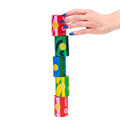
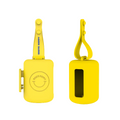
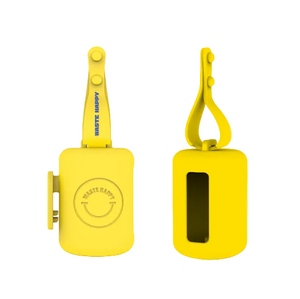
So note where it landed before the grass starts flying, and keep a bag within reach. (Here is how to attach a poop bag dispenser to a leash.)
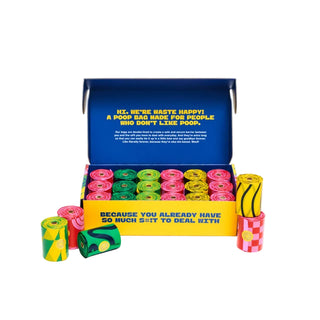
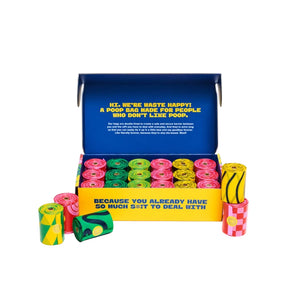
However big the kick, the walk ends the same way. Take the quiz to see how many bags your dog actually needs each month, or grab a box so the only thing your dog leaves behind is a message.
This article is general information, not veterinary advice. If your dog has sore or bleeding paw pads, is scooting, or is straining to poop, talk to your vet.
Sources
- American Kennel Club, Why Does My Dog Kick the Grass After Pooping?
- American Kennel Club, Why Does My Dog Kick Her Back Legs Over Her Poop? (a Nicholas Dodman column first printed in AKC Family Dog)
- Cummings School of Veterinary Medicine at Tufts University, Nicholas H. Dodman
- VCA Animal Hospitals, Why Do Dogs Kick Grass After Relieving Themselves?
- McClanahan and Rosell, Conspecific Recognition of Pedal Scent in Domestic Dogs, Scientific Reports, 2020
- Cafazzo, Natoli and Valsecchi, study of scent marking in a pack of free-ranging domestic dogs, Ethology, 2012
- McGuire et al., Sex of Walker Influences Scent-Marking Behavior of Shelter Dogs, Animals, 2020
- Bekoff, Ground Scratching by Male Domestic Dogs: A Composite Signal, Journal of Mammalogy, 1979
- Cornell University College of Veterinary Medicine, Anal Sac Diseases
- VCA Animal Hospitals, Tapeworm Infection in Dogs
- VCA Animal Hospitals, Constipation in Dogs
- VCA Animal Hospitals, Anal Sac Disease in Dogs