







In one study, dogs only picked out their owner's face when they could see the outline of the head. Why costumes set off barking, the signs your dog is scared, and how to help.
You put on the mask. You walk into the living room. Your dog, who has known you for years, plants their feet and barks at you like you just broke in.
Rude? A little. But researchers have tested what dogs need to see to recognize a familiar face, and the answer may explain a lot about Halloween.
The short answer
Dogs read our faces closely, so masks and costumes can confuse or alarm them, and alarmed dogs bark. In one study, dogs could only pick out their owner when the outline of the head was visible. Our guess: a mask that hides it can make you look like a stranger. Go slow, and never force it.
What dogs need to see to recognize you
We have covered how dogs see color in can dogs see fall colors. Faces are a different question, and a team from the University of Padua in Italy and Trent University in Canada set out to answer it.
In a 2017 study in Animal Cognition, dogs were shown their owner's head and a stranger's head, poking through openings on opposite sides of a test area. If dogs went to their owner more often than chance would predict, the researchers counted it as recognition.
Sometimes the heads were easy to see. Other times they were not facing the dog, the lighting was uneven, and the outline of each head (the outer contour, in the paper's words) was hidden. A second experiment looked at which of those three changes was the problem.
The outline was what mattered. The authors called their results the first clear demonstration of dogs recognizing human faces, and concluded that the outer parts of the face are crucial. (Male dogs were slightly better at it than females, for the record.) The study did not test masks, costumes or barking.
Why your dog might bark at you in costume
This next part is our inference, not something the study tested. A rubber mask, a hood, a wig or a big witch hat changes or hides the outline of your head, which is exactly what those dogs needed to see. So when you walk in wearing one, your dog may not see you at first. They may see a stranger in their kitchen.
Experts point to the face, too. Dr. Jerry Klein, chief veterinarian of the American Kennel Club, says dogs depend on our faces and expressions to read us, so masks can leave them confused or uneasy. When face masks became part of everyday life in 2020, Dr. Stephanie Borns-Weil, who heads the behavior service at Tufts University's Cummings Veterinary Medical Center, wrote that things covering our faces "can be alarming" for dogs, "especially when introduced suddenly." Some, she noted, "may bark furiously at the masked 'enemies' invading their neighborhood streets."
From your dog's side, the barking makes sense. According to the ASPCA, territorial behavior is "often motivated by both fear and anticipation of a perceived threat," and alarm barking is set off by sights and sounds that startle or upset a dog. A masked stranger in the kitchen covers both.

Why the decorations get barked at, too
The house down the street now has a tombstone, a cackling witch and a skeleton that lights up when you walk past. Plenty of decorations are built to startle people with sudden noise, motion or light, the AKC notes, so even confident dogs may find them unnerving.
The fix is distance. If a display looks especially intimidating, cross the street, and reward your dog for calmly looking at it from wherever they feel comfortable. Do not march them up to the skeleton to prove it is fake: the AKC warns that forcing the meeting can deepen a dog's fear and make the next reaction worse.
Signs your dog is scared, not just loud
Barking is the obvious sign. Dr. Rachel Malamed, a veterinarian and board-certified veterinary behaviorist quoted by the AKC, lists quieter signs that might mean fear:
- A tucked tail, or ears pulled back
- Pacing and restlessness
- Shaking or cowering
- Moving in slow motion
- Refusing treats
- Hyper-vigilance
- Yawning, lip licking or panting
Around decorations, the AKC adds lunging, freezing, pulling away and a stiff posture. If your dog will not take treats, ignores toys or cannot respond to cues they know, they are likely too close to whatever is bothering them, so move farther away.
How to help your dog through costume season
Halloween is Saturday. That is enough time to start, not to finish, so go at your dog's pace.
- Let your dog sniff the costume first. In an AKC article written when face masks were new, dog trainer Gayle Watkins suggested starting with the mask on its own: "show your dog the mask," she said. "Let him sniff it." That nose is extraordinary (we dug into what it can pick up in why does my dog lick me), so let it have the first look.
- Put masks on and take them off in front of them, with treats. Certified professional dog trainer Vicki Ronchette suggests a game: pull your shirt over half your face, then let it drop while you play or hand out treats. Then work up to short stretches in the real mask at good moments. As Watkins put it: "Put the mask on and walk to the cookie jar." Keep sessions to about five minutes, Dr. Borns-Weil advises, and back up if your dog pants, licks their lips, yawns repeatedly or turns away. "Think tortoise, not hare."
- Do not force a costume onto your dog. The ASPCA recommends skipping the costume unless you know your dog loves it, and switching to a festive bandana if they seem distressed. If you try one, follow the AKC's advice for dog clothes: let your dog explore and sniff it first, reward any interest, and take it off if they seem stressed. As Ronchette said about masks, "Force cannot help with fear." Our dog Halloween costume and safety guide covers fit and choking hazards.
- Give them a quiet room away from the door. "Many strangers in costume can be extremely scary and stressful for dogs," Dr. Malamed says. Unless your dog is truly social, the ASPCA recommends a cozy room far from the front door for the busiest trick-or-treating hours, with a favorite chew or food puzzle toy.
- On the trick-or-treat walk, keep a short leash. Dr. Klein's advice is to keep dogs indoors during trick-or-treating hours and to walk before dark if you can, since Halloween night can leave sidewalks littered with candy and wrappers (more in the AKC's Halloween safety tips, and in ours on how much chocolate is toxic to dogs). If your dog comes along, the ASPCA warns that crowds and strange costumes can spook pets and cause them to bolt, so use a reflective collar, a secure leash and proper ID after dark. Keep the leash short, so your dog stays beside you instead of nose to nose with a masked stranger (our reasoning), but not tight: the AKC notes that tension on the leash can unintentionally signal that something is wrong. And with the clocks falling back the next morning, here is how to shift your dog's schedule.
If your dog barks at you anyway
Take the mask off and let them see and sniff you, then try again another day from an easier step. Do not use treats to lure a scared dog toward a masked face: Ronchette warns that a dog may come close to something that scares them just to get the food. And do not scold. The ASPCA warns that punishing a dog that barks out of fear or anxiety could make them feel worse, and the barking might increase.
If your dog is truly terrified, skip the costumed crowds this year. "It is best to avoid this type of exposure if you have a fearful animal," Dr. Malamed says. If the fear or barking is intense, or lasts past Halloween, start with your vet. The ASPCA notes that some dogs bark because of pain, and recommends a vet exam to rule out medical causes. A board-certified veterinary behaviorist can take it from there.
Happy Halloween, stranger
Your dog is not being dramatic. They are doing what dogs do when a stranger shows up, and on Halloween, the stranger might be you.
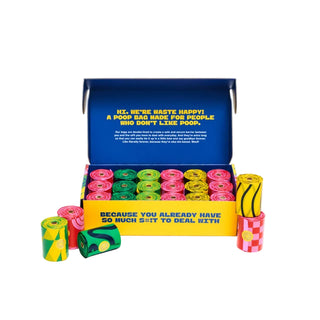
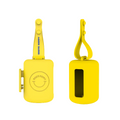
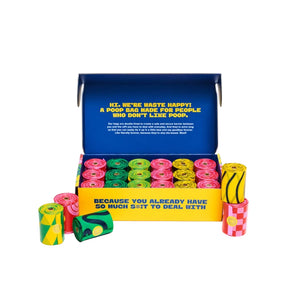
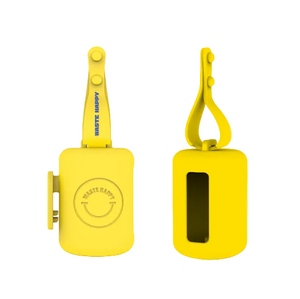
Whoever your dog thinks you are on Saturday night, the walk ends the same way. A dispenser on the leash keeps a bag within reach (here is how to attach one). Take the quiz to see how many bags your dog actually needs each month, or grab a box so you are never caught short on Halloween night.
This article is general information, not veterinary advice. If your dog's fear or barking is intense, or lasts past Halloween, talk to your vet.
Sources
- Mongillo P, Scandurra A, Kramer RSS, Marinelli L. Recognition of Human Faces by Dogs (Canis familiaris) Requires Visibility of Head Contour. Animal Cognition, 2017; 20(5): 881-890
- American Kennel Club, What Do Dogs Really Think About Halloween?
- American Kennel Club, Halloween Safety Tips for Dogs: Avoid Common Holiday Hazards, by Dr. Jerry Klein
- American Kennel Club, How to Help Your Dog Feel Comfortable Around Halloween Decorations
- American Kennel Club, Training Dogs to be Comfortable Around People in Face Masks
- American Kennel Club, How to Get Your Dog Comfortable Wearing Clothes for Hot and Cold Weather
- Cummings School of Veterinary Medicine at Tufts University, Managing Mask Phobia in Dogs, April 22, 2020
- ASPCA, Barking
- ASPCA, Halloween Safety Tips